
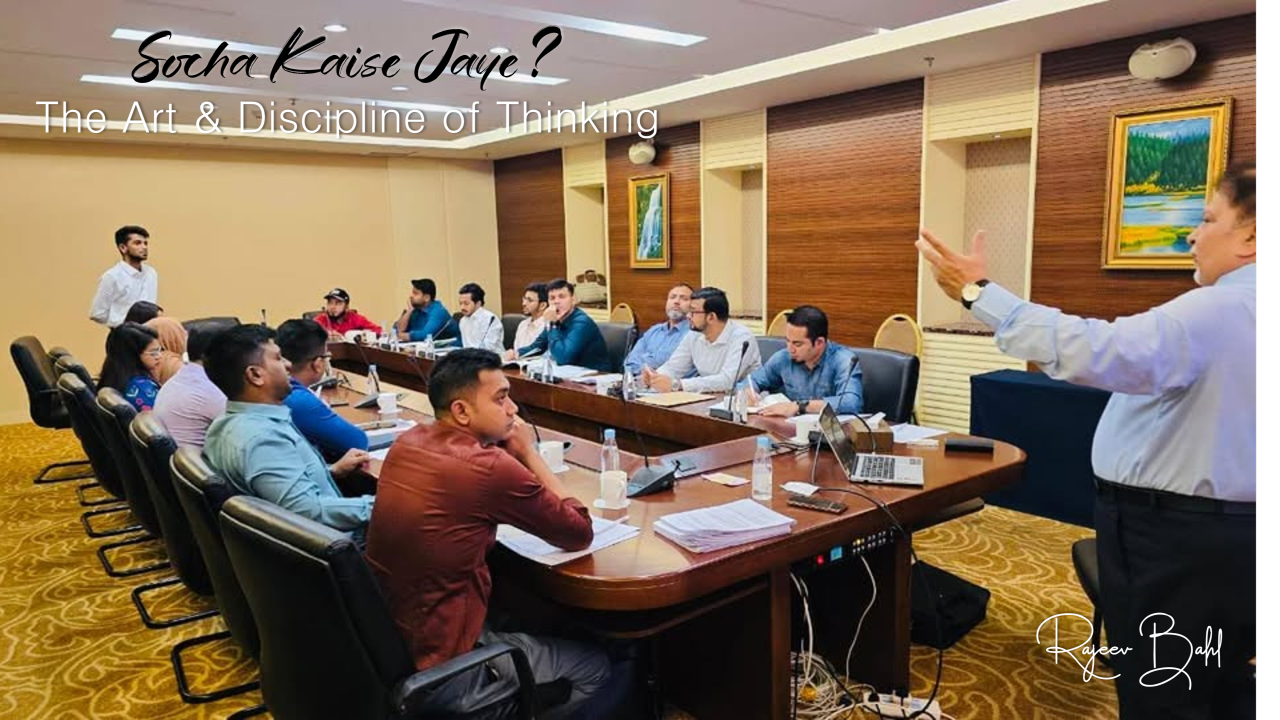
A Question We Were Never Really Taught
Most of us spend nearly two decades in schools and universities.
We learn mathematics, science, management, technology, and many specialized subjects. We are tested on our memory, our ability to reproduce information, and sometimes on our ability to apply formulas.
But there is one skill that rarely becomes part of our formal education.
The skill of thinking.
Not what to think. But how to think.
Over the past four decades of my professional journey, working with managers, professionals, and leaders across industries, I have observed something very interesting.
Many highly qualified and intelligent people struggle with decisions.
They struggle with clarity. They struggle with prioritization. They struggle with judgement.
Not because they lack knowledge.
But because they have never consciously developed a discipline of thinking.
Very often our thinking follows patterns that we are not even aware of.
Sometimes we assume things without verifying them.
Sometimes we follow the majority simply because everyone else is doing the same.
At times we react emotionally in the moment rather than pausing to reflect.
And quite often we jump to conclusions without exploring alternatives.
These patterns are not signs of lack of intelligence. They are simply the result of untrained thinking.
The truth is that thinking, like any other skill, can be improved.
In fact, good thinking often begins with something very simple — the willingness to pause.
- To pause before reacting.
- To pause before concluding.
- To pause before deciding.
Once we pause, the process of thinking can become more structured.
For instance, whenever we face a decision or a challenge, we can ask ourselves a few basic questions:
- What exactly is the real situation here?
- What are the possible options available to me?
- What might be the consequences of each option?
And finally, what decision aligns best with the long-term outcome I want?
These questions may appear simple, but they introduce clarity where confusion usually exists.
Over time I began reflecting on this idea more deeply.
- Why do some individuals consistently make wiser decisions than others?
- Why do some leaders bring clarity even in complex situations?
- Why do some professionals grow steadily while others remain stuck despite having similar qualifications?
Very often the difference lies not in knowledge, but in the way they think.
This reflection has led me to explore and develop a concept that I call:
“Socha Kaise Jaye” – The Art and Discipline of Thinking.
The purpose of this idea is not philosophical. It is deeply practical.
In a world overflowing with information, opinions, and constant noise, the ability to think clearly may be one of the most valuable capabilities a person can develop.
Clear thinking helps us make better professional decisions.
It helps leaders guide teams with confidence.
It helps individuals navigate uncertainty without unnecessary anxiety.
And perhaps most importantly, it helps us live more consciously.
Because ultimately, our choices shape our direction in life.
And our choices are shaped by our thinking.
This raises a question that I find increasingly important:
Should thinking itself be taught as a skill?
Should young professionals be trained not only in knowledge and technical expertise, but also in how to examine situations, question assumptions, and make thoughtful decisions?
I believe the answer may well shape the future of leadership and learning.
I would genuinely value hearing your perspective.
Do you believe thinking can be trained and improved?